Mysterious Gas Leaks Suggest Mars May Still Be Volcanically Active
Researchers have identified unusual hydrogen chloride emissions near Martian volcanic fractures, suggesting the planet may retain active internal geological processes.
 🔬Science & Health
Photo: ScienceDaily
Key points
- Hydrogen chloride gas detected escaping from volcanic fractures on Mars.
- Evidence suggests the presence of subterranean magma chambers and potential hydrothermal systems.
- Findings challenge the long-held belief that Mars is a geologically dead planet.
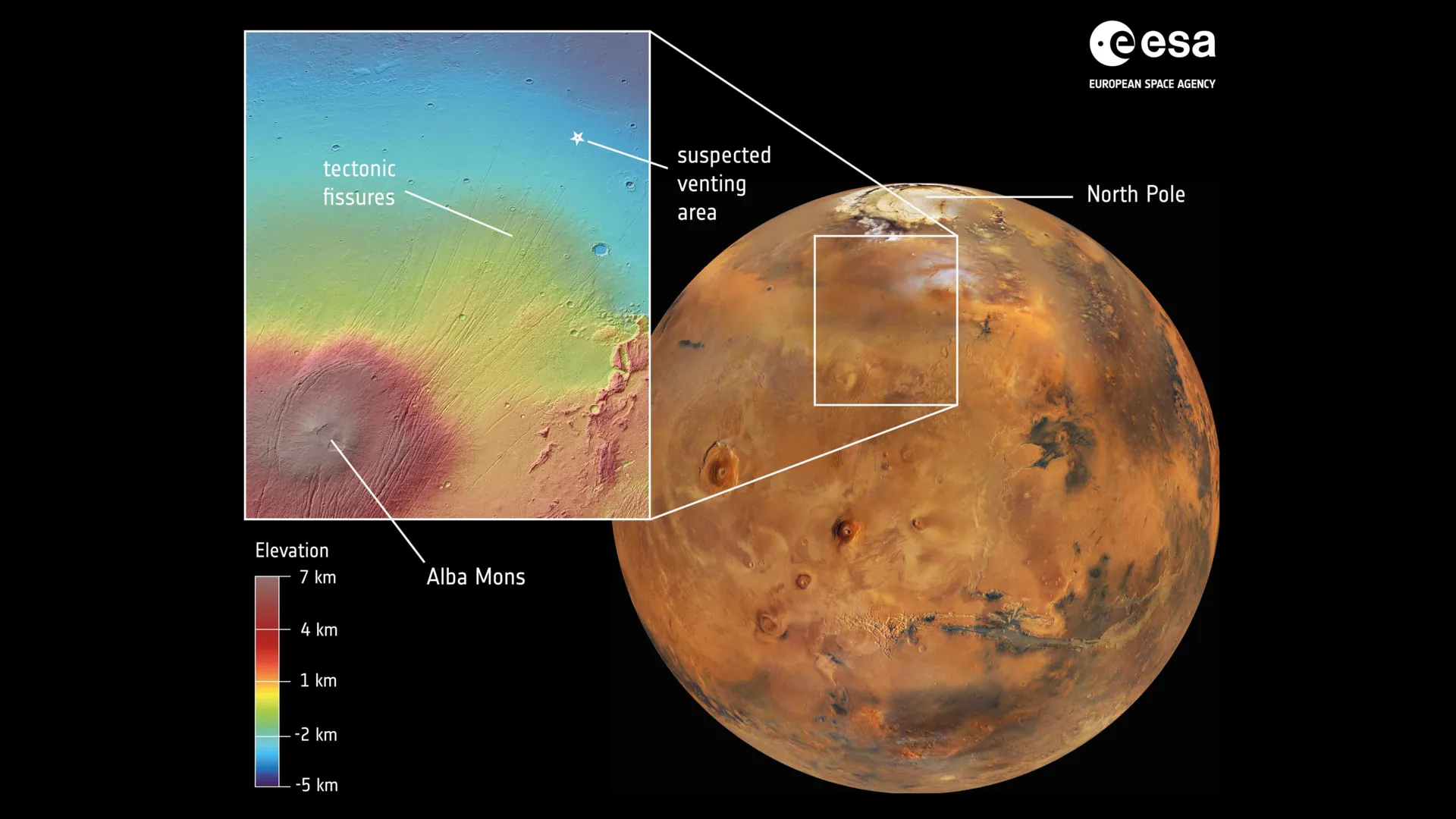
New atmospheric data from the European Space Agency’s ExoMars Trace Gas Orbiter indicates that Mars may be more geologically alive than previously thought. Scientists have detected recurring concentrations of hydrogen chloride gas escaping from fractures in the Alba Mons volcanic region, a phenomenon that deviates from the planet's typical seasonal atmospheric cycles.
Led by Alexander Trokhimovskiy, an international research team posits that these emissions originate from magma chambers deep beneath the surface. On Earth, similar gas releases are common near volcanic vents known as fumaroles. The researchers suggest that during the extreme cold of the Martian winter, ice seals these surface cracks, trapping gases until rising temperatures in early summer allow them to escape.
High-resolution imagery from the orbiter revealed fresh-looking fractures and surface discoloration near the emission sites, further supporting the theory of active subterranean volcanic systems. While no active lava flows or eruptions have been directly observed, the presence of these gases suggests that Mars retains sufficient internal heat to support ongoing volcanic activity.
Our findings suggest that Mars has retained enough internal heat to support volcanic activity until recently, and possibly still does.
The discovery has significant implications for the study of Martian habitability. If hydrothermal systems are generated by underground volcanic heat, they could potentially provide the chemical energy and protection necessary for microorganisms to survive beneath the planet's harsh surface.
Source ScienceDaily — sciencedaily.com/releases/2026/11/261106174525.htm ↗
Read next
 📈Economy
Japan Tobacco Shares Rise Amid Potential Imperial Brands Takeover Bid
Japan Tobacco shares rose following reports of a potential partnership to acquire British cigarette maker Imperial Brands, which is also being eyed by Altria.
 🏛️Politics
Philippine digital activists scrutinize 2027 national budget for corruption
A growing movement of Filipino influencers and tech professionals is utilizing digital tools to audit government spending and identify potential red flags in the 2027 nat…
 📈Economy
Argentina Bans Central Bank From Printing Money to Fund Government
Argentina's Congress has passed legislation prohibiting the central bank from financing government spending, marking a major shift in the nation's fiscal policy.
 🏛️Politics
DOJ Reportedly Lacked Access to Rubio Memo in Nvidia CEO Investigation
The U.S. Department of Justice reportedly never received a key intelligence memo that triggered the brief ouster of Nvidia CEO Jensen Huang. The revelation adds complexit…
 🏛️Politics
New Book Alleges Financial Ties Between Jared Kushner and Gulf States
A new book by journalist Matthew Cole alleges that Jared Kushner received $2 billion in funding from Saudi and Emirati sources during his time as a Trump administration o…
EU Budget Summit Concludes Early as Key Appointments Announced
European leaders have wrapped up budget discussions prematurely, while Pablo Hernández de Cos is tapped to lead the European Central Bank.