Ancient Fossil Study Rewrites the Evolutionary History of Vertebrate Necks
New research reveals that the earliest animals to walk on land possessed remarkably rigid necks, challenging the long-held belief that head mobility drove the evolution of the neck.
 🔬Science & Health
Photo: ScienceDaily
Key points
- Early land animals had stiff necks contrary to previous beliefs
- Neck evolution was tied to limb movement rather than head mobility
- Findings published in Nature on October 14 use fossils and modern models
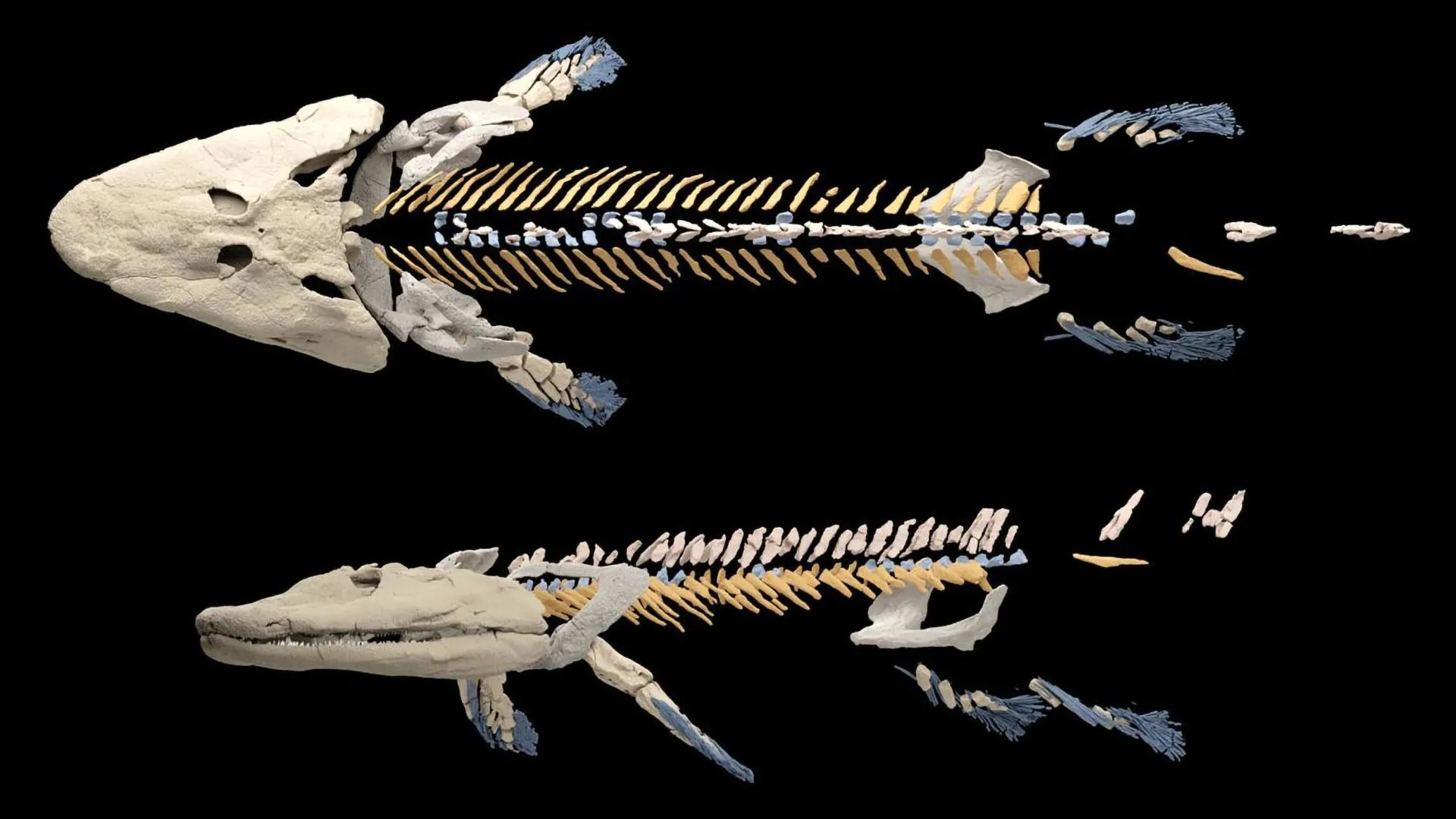
Pioneering creatures that moved from aquatic environments to terrestrial habitats approximately 380 million years ago faced a surprising physiological restriction. Rather than gaining immediate freedom to scan their surroundings, these early four-limbed ancestors operated with very stiff necks, according to a study published on October 14 in the journal Nature.
For decades, evolutionary biologists maintained that separating the skull from the shoulder girdle provided animals with the ability to spot prey and evade predators without shifting their entire bodies. However, an international team analyzing fossil evidence, computer simulations, and living biological analogues discovered that these early anatomical alterations were actually linked to broader skeletal modifications. The structural shifts allowed creatures to utilize their front appendages for locomotion rather than enhancing head rotation.
Because critical components of the ancient vertebral column consisted of soft tissue that rarely survived in the fossil record, researchers relied on modern comparisons and specimens like Tiktaalik, discovered in Nunavut, Canada. These findings demonstrate that the initial divergence between the head and shoulders served a mechanical purpose for limb movement, fundamentally altering how scientists view a pivotal milestone in vertebrate development.
Source ScienceDaily — sciencedaily.com/releases/2026/11/261108233101.htm ↗
Read next
 📈Economy
Japan Tobacco Shares Rise Amid Potential Imperial Brands Takeover Bid
Japan Tobacco shares rose following reports of a potential partnership to acquire British cigarette maker Imperial Brands, which is also being eyed by Altria.
 🏛️Politics
Philippine digital activists scrutinize 2027 national budget for corruption
A growing movement of Filipino influencers and tech professionals is utilizing digital tools to audit government spending and identify potential red flags in the 2027 nat…
 📈Economy
Argentina Bans Central Bank From Printing Money to Fund Government
Argentina's Congress has passed legislation prohibiting the central bank from financing government spending, marking a major shift in the nation's fiscal policy.
 🏛️Politics
DOJ Reportedly Lacked Access to Rubio Memo in Nvidia CEO Investigation
The U.S. Department of Justice reportedly never received a key intelligence memo that triggered the brief ouster of Nvidia CEO Jensen Huang. The revelation adds complexit…
 🏛️Politics
New Book Alleges Financial Ties Between Jared Kushner and Gulf States
A new book by journalist Matthew Cole alleges that Jared Kushner received $2 billion in funding from Saudi and Emirati sources during his time as a Trump administration o…
EU Budget Summit Concludes Early as Key Appointments Announced
European leaders have wrapped up budget discussions prematurely, while Pablo Hernández de Cos is tapped to lead the European Central Bank.