Ancient Oceans Masked Earth’s True Oxygen History, Study Reveals
A new geochemical analysis indicates that Earth's atmospheric oxygen rose in three major stages, while deep oceans lagged behind by hundreds of millions of years.
 🔬Science & Health
Photo: ScienceDaily
Key points
- Atmospheric oxygen rose in three major stages, challenging traditional timelines.
- Deep oceans lagged behind atmospheric oxygenation by up to 600 million years.
- Researchers used oxygen-17 isotope signatures in sulfate to track ancient air directly.
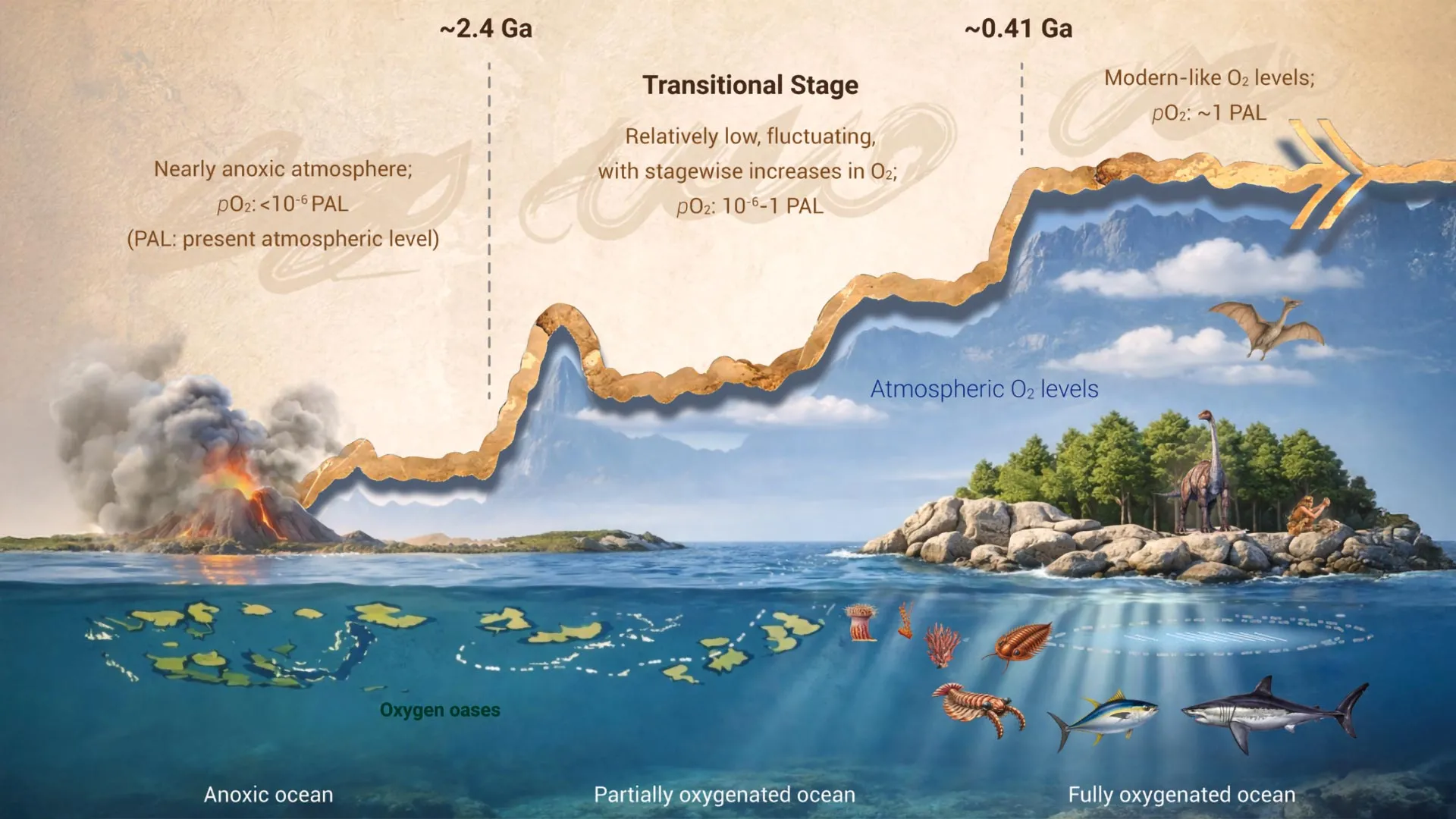
Earth's atmosphere accumulated oxygen through three distinct historical phases while deep oceans experienced massive delays in catching up, according to a newly published scientific analysis. Researchers from Chengdu University of Technology presented a revised timeline in The Innovation, challenging traditional assumptions about how the planet's oxygen levels evolved.
Historically, scientists reconstructed ancient atmospheric oxygen by examining chemical clues locked inside ocean sediments. However, seawater chemistry is frequently skewed by biological productivity, nutrient availability, and basin geometry. To bypass these limitations, the researchers analyzed sulfate compounds bearing a distinct shortage of the oxygen-17 isotope, which acts as a direct chemical fingerprint of ancient atmospheric conditions.
The revised findings show that Earth's initial major oxygen rise occurred during the Great Oxidation Event between 2.4 billion and 2.1 billion years ago. Subsequent increases followed roughly 1.3 billion to 1.0 billion years ago and between 440 million and 410 million years ago, significantly shifting earlier timelines. According to the data, deep oceans lagged behind these atmospheric milestones by gaps stretching up to 600 million years.
Furthermore, the data suggests that atmospheric and oceanic oxygen levels occasionally moved in opposite directions over million-year timescales. As fresh oxygen entered marine environments, it reacted with accumulated organic carbon and sulfide, temporarily drawing down oxygen in the air. This inverse relationship could force a widespread reinterpretation of ancient climate and geological records.
Source ScienceDaily — sciencedaily.com/releases/2026/11/261122060340.htm ↗
Read next
 📈Economy
Japan Tobacco Shares Rise Amid Potential Imperial Brands Takeover Bid
Japan Tobacco shares rose following reports of a potential partnership to acquire British cigarette maker Imperial Brands, which is also being eyed by Altria.
 🏛️Politics
Philippine digital activists scrutinize 2027 national budget for corruption
A growing movement of Filipino influencers and tech professionals is utilizing digital tools to audit government spending and identify potential red flags in the 2027 nat…
 📈Economy
Argentina Bans Central Bank From Printing Money to Fund Government
Argentina's Congress has passed legislation prohibiting the central bank from financing government spending, marking a major shift in the nation's fiscal policy.
 🏛️Politics
DOJ Reportedly Lacked Access to Rubio Memo in Nvidia CEO Investigation
The U.S. Department of Justice reportedly never received a key intelligence memo that triggered the brief ouster of Nvidia CEO Jensen Huang. The revelation adds complexit…
 🏛️Politics
New Book Alleges Financial Ties Between Jared Kushner and Gulf States
A new book by journalist Matthew Cole alleges that Jared Kushner received $2 billion in funding from Saudi and Emirati sources during his time as a Trump administration o…
EU Budget Summit Concludes Early as Key Appointments Announced
European leaders have wrapped up budget discussions prematurely, while Pablo Hernández de Cos is tapped to lead the European Central Bank.