Voyager 1 Reaches 25.9 Billion Kilometers During Interstellar Mission
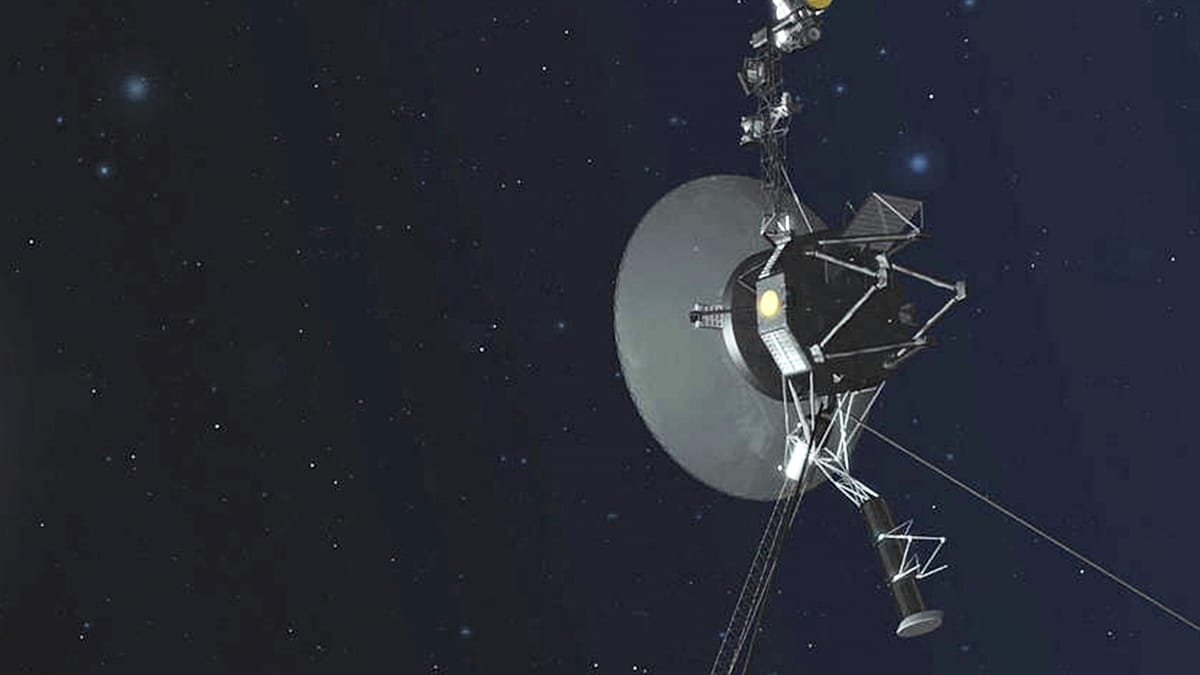
NASA’s Voyager 1 has reached a record distance of 25.9 billion kilometers from Earth, continuing its mission nearly 50 years after launch despite aging hardware.
 🔬Science & Health
Photo: Euronews
Key points
- Voyager 1 is currently 25.9 billion kilometers from Earth, travelling at 17 kilometers per second.
- NASA has successfully managed recent technical failures involving 1970s-era computers and clogged thrusters.
- The spacecraft carries a Golden Record intended for extraterrestrial civilizations, featuring sounds and images of Earth.
NASA’s Voyager 1 spacecraft has reached a historic distance of approximately 25.9 billion kilometers from Earth, maintaining its status as the most distant human-made object. Launched nearly 50 years ago, the probe continues to transmit data from interstellar space despite significant hardware degradation and power shortages.
The mission began on September 5, 1977, at Cape Canaveral, Florida, with a primary goal of exploring the outer planets. After flying past Jupiter in 1979 and Saturn in 1980, Voyager 1 utilized gravitational assists to reach its current speed of 61,000 kilometers per hour. In August 2012, it became the first human spacecraft to cross the heliopause and enter interstellar space.
Maintaining the aging probe requires complex remote engineering on 1970s-era hardware. NASA engineers recently resolved a computer malfunction that halted data transmission in November 2023 and bypassed clogged thruster pipes in 2024. However, the decay of its plutonium power source has forced the agency to shut down various instruments to conserve energy, including a recent deactivation in April 2026.
Beyond its scientific payload, Voyager 1 carries a 30-centimeter Golden Record containing 115 images, greetings in 55 languages, and music ranging from Bach to Chuck Berry. While the probe will eventually lose the power necessary to communicate with Earth, it is expected to drift through the galaxy for millions of years, reaching the Oort Cloud in roughly 300 years.
Source Euronews — euronews.com/2026/11/18/voyager-1-now-259-billion-km-from-earth-sti… ↗
Read next
 📈Economy
Japan Tobacco Shares Rise Amid Potential Imperial Brands Takeover Bid
Japan Tobacco shares rose following reports of a potential partnership to acquire British cigarette maker Imperial Brands, which is also being eyed by Altria.
 🏛️Politics
Philippine digital activists scrutinize 2027 national budget for corruption
A growing movement of Filipino influencers and tech professionals is utilizing digital tools to audit government spending and identify potential red flags in the 2027 nat…
 📈Economy
Argentina Bans Central Bank From Printing Money to Fund Government
Argentina's Congress has passed legislation prohibiting the central bank from financing government spending, marking a major shift in the nation's fiscal policy.
 🏛️Politics
DOJ Reportedly Lacked Access to Rubio Memo in Nvidia CEO Investigation
The U.S. Department of Justice reportedly never received a key intelligence memo that triggered the brief ouster of Nvidia CEO Jensen Huang. The revelation adds complexit…
 🏛️Politics
New Book Alleges Financial Ties Between Jared Kushner and Gulf States
A new book by journalist Matthew Cole alleges that Jared Kushner received $2 billion in funding from Saudi and Emirati sources during his time as a Trump administration o…
EU Budget Summit Concludes Early as Key Appointments Announced
European leaders have wrapped up budget discussions prematurely, while Pablo Hernández de Cos is tapped to lead the European Central Bank.