Uzbekistan Overhauls Agricultural Sector to Boost Exports and Efficiency
Uzbekistan is implementing advanced irrigation, digital technology, and financial incentives to modernize its agricultural sector and combat water scarcity. The government aims to reach $10 billion in food exports by 2030 while strengthening domestic food security.
 📈Economy
Photo: Euronews
Key points
- Government targets $10 billion in annual food exports by 2030.
- New irrigation projects aim to save 540 million cubic meters of water annually.
- Modern orchard techniques have increased fruit yields from 10 tonnes to up to 60 tonnes per hectare.
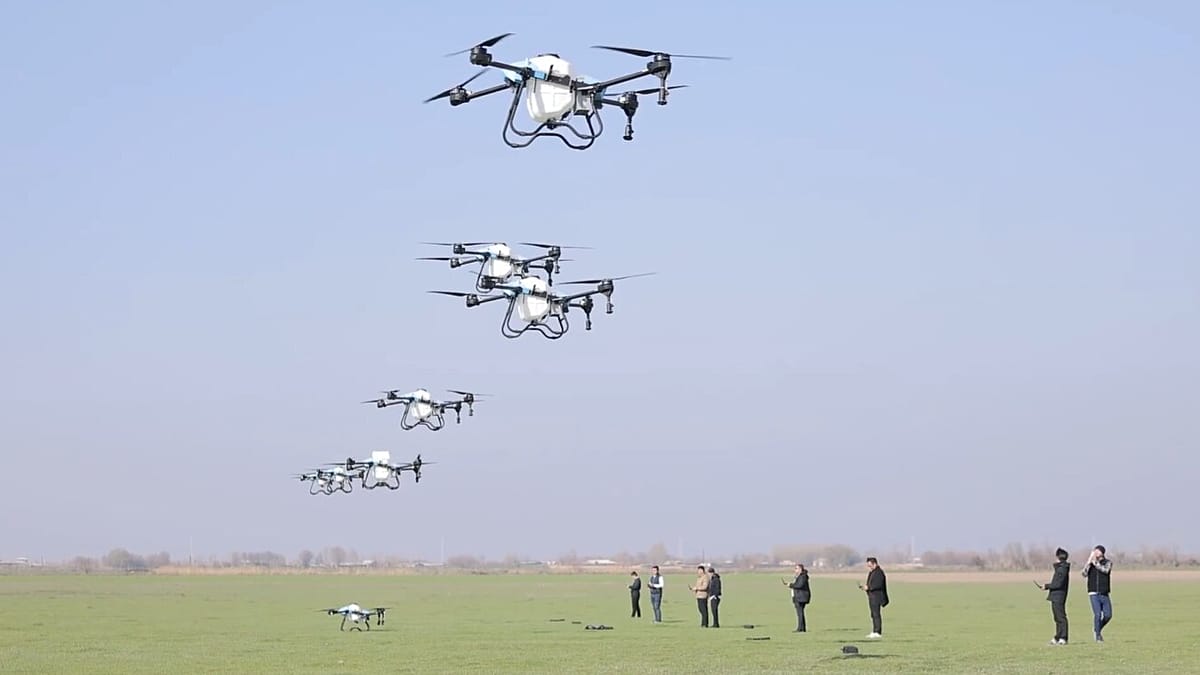
- Introduction of 100 agricultural drones for pest control and crop monitoring.
Uzbekistan is aggressively restructuring its agricultural sector, moving away from traditional land-intensive farming toward high-yield, technology-driven production. By integrating satellite monitoring, AI-based forecasting, and drone technology, the government aims to maximize output while addressing significant water scarcity issues. Agriculture currently consumes approximately 90% of the nation's water, prompting a $200 million World Bank-backed project to modernize irrigation infrastructure across five regions.
To support this transition, the government has launched financial initiatives including preferential loans of up to 120 million soums per hectare for orchard development and annual maintenance subsidies. These efforts have already yielded results: modern dwarf rootstock orchards are now producing up to 60 tonnes of fruit per hectare, significantly outperforming traditional methods. Furthermore, the country has reduced its cotton acreage while maintaining production levels, allowing for a strategic shift toward higher-value crops.
International partnerships, including collaborations with the Global Green Growth Institute and the European Bank for Reconstruction and Development, are facilitating green bonds and investment platforms to mobilize capital. Despite these advancements, the nation remains reliant on imports for essential goods like sugar and vegetable oil. The government’s 2026–2030 strategy focuses on bridging this gap by enhancing domestic processing capabilities and expanding the reach of its fruit and vegetable exports to 92 international markets.
Source Euronews — euronews.com/2026/11/10/inside-uzbekistans-agricultural-transformat… ↗
Read next
 🏛️Politics
Philippine digital activists scrutinize 2027 national budget for corruption
A growing movement of Filipino influencers and tech professionals is utilizing digital tools to audit government spending and identify potential red flags in the 2027 nat…
 🏛️Politics
DOJ Reportedly Lacked Access to Rubio Memo in Nvidia CEO Investigation
The U.S. Department of Justice reportedly never received a key intelligence memo that triggered the brief ouster of Nvidia CEO Jensen Huang. The revelation adds complexit…
 🏛️Politics
New Book Alleges Financial Ties Between Jared Kushner and Gulf States
A new book by journalist Matthew Cole alleges that Jared Kushner received $2 billion in funding from Saudi and Emirati sources during his time as a Trump administration o…
EU Budget Summit Concludes Early as Key Appointments Announced
European leaders have wrapped up budget discussions prematurely, while Pablo Hernández de Cos is tapped to lead the European Central Bank.
 💻Tech
Researchers Use AI to Optimize Molecular Cage Catalysts
Scientists from the universities of Birmingham, Edinburgh, and Oxford have developed a high-speed screening method paired with machine learning to identify highly efficie…
 🌍World
Diplomatic Tensions Rise After Clashes at Besiktas-Hapoel Football Match
A UEFA Europa League match between Turkey's Besiktas and Israel's Hapoel Beer-Sheva in Georgia was disrupted by violent clashes between fans and police, triggering a dipl…